Law relating to names
A concise overview of how a change of name is recognised, evidenced, and published for proof of use.
Common law and use
In England and Wales your legal name is the one you are generally known by. A legal name, under common law, consists of one Christian name and one surname (Black's 4th). However, you can adopt a new name through consistent use and reputation, provided it is in good faith and not for fraud.
Public, consistent use is the substance; documents are evidence, not permission. A public notice with a timestamp is strong proof that the change is genuine and made openly.
“An individual may acquire a new name by ‘use and reputation’ (ie by adopting a new name in practice). More formal methods, such as a deed poll or a statutory declaration, provide documentary evidence of the change. The law governing a change of name is currently a combination of common law (case law) and, in the case of enrolment of deed polls, regulations made by the Master of the Rolls.” — Parliamentary Research Briefings, Number CDP 2023 0044
Key case: Re Parrott, Cox v Parrott (1946)
The High Court confirmed that adopting a new name by deed poll and use is effective; a royal licence is not required unless a will or trust explicitly demands it. Vaisey J described a name as “the one thing which inalienably belongs” to a person and refused to let a will over-control identity.
The judgment also noted that private instruments often focus on surnames; the court would not rewrite a person’s “Christian name” on deed poll simply to satisfy a testamentary condition. Practice still centres on use and reputation, with civil courts chiefly policing surname conditions, not first-name identity.
First names, surnames, and no-surname option
- First name (forename/given name) is the name you are called and known by; courts accept you can sue or be sued by that name if that is how you are known. Authority: Williams v Bryant (1839), King v Inhabitants of Billingshurst (1814), Walden v Holman (1704).
- A Christian name may consist of a single letter. Authority: Wharton; Black's 4th.
- Surnames were less important historically than given names. Surnames can be abandoned, or changed at will and are established by use and reputation. We know of no historic cases that show an Act of Parliament prevents abandonment or that a licence is needed. Indeed, a surname can be abandoned by enrolled deedpoll at the High Courts of England and Wales.
- First names can change by use and repute just as surnames can; formal documents (deed poll/statutory declaration) are evidential, not constitutive.
“Præsentia corporis tollit errorem nominis; et veritas nominis tollit errorem demonstrationis.”
“The presence of the body removes error in the name; and the truth of the name removes error in the description.”
— Herbert Broom, A Selection of Legal Maxims, Classified and Illustrated, 4th ed. (London: William Maxwell, 32 Bell Yard, Lincoln’s Inn, 1864), p. 614 (first clause) and p. 616 (second clause).
“God formede hem male and female, and blesside hem, and clepide the name of hem Adam, in the day in which thei weren formed.” — Wycliffe (C1382), Genesis 5:2 (illustrating long-standing use of “name” to denote identity, not just a label)
Evidence you can show
- Deed poll (unenrolled or enrolled) or a statutory declaration recording the change.
- Published notice that timestamps the change and links former and new names.
- Consistent use across records supported by documents.
Reasonable restrictions on names
UK record holders can refuse names that are impossible to record or clearly problematic. Common refusals include:
- Names that are offensive, promote crime or hate, or contain slurs.
- Misleading titles or ranks (e.g. “Sir”, “Lord”, “Dr”) when not entitled.
- Symbols or numbers most systems cannot store; excessively long or unpronounceable strings.
- Names chosen for fraud or to impersonate someone else.
Definitions (OED, 1933)
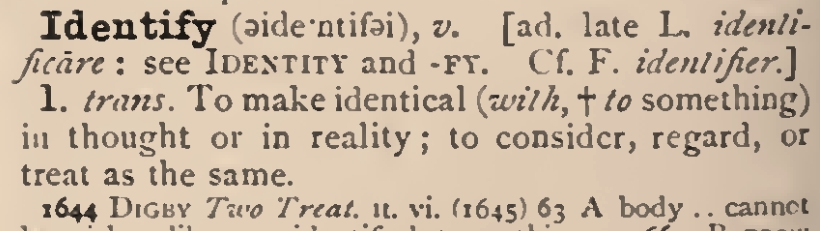
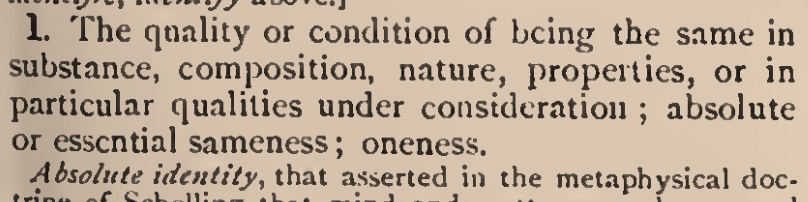
Adopt
Meaning, Origin, and Legal Effect
1. Etymology and Original Meaning
The word adopt derives from the Latin adoptare, formed from:
- ad — “to” or “towards”
- optare — “to choose”, “to desire”
Its literal meaning is therefore:
“to choose for oneself” or “to take by deliberate choice.”
From its earliest usage, adopt has never meant mere use, temporary holding, or passive acceptance. It has always denoted an active act of will, whereby something is intentionally taken as one’s own.
2. Adoption in Roman Law
In Roman law, adoption was a formal legal act with profound consequences for status.
There were two principal forms:
(a) Adoptio
- The adoption of a person under the authority of another (in patria potestate).
- Typically involved a child.
- Transferred the child from one household to another.
- The adopted person became, in law, as if born to the adopter.
(b) Adrogatio
- The adoption of a person who was already sui juris (independent).
- Required public authority.
- Transferred not merely family ties but entire legal status, including name and lineage.
In both cases, adoption was not symbolic. It effected a real transfer of identity, allegiance, and standing.
A central Roman principle applies:
Nomen sequitur statum
The name follows the status.
The name did not create the status; the status of the adopter determined the legal character of the name.
3. Adoption in Common Law
English common law historically did not recognise adoption of persons in the Roman sense, but the concept of adoption remained intact in language and legal usage.
In common law, to adopt meant:
- To formally accept
- To take ownership by choice
- To make binding by assent
Examples include:
- Adoption of resolutions by Parliament
- Adoption of rules or articles
- Adoption of customs or practices
In each case, adoption signifies intentional assumption, not passive use.
4. Adoption of a Name at Common Law
At common law, a man has the natural right to be known by any name he chooses, provided there is no fraud.
Blackstone affirms that:
- A man’s name is an incident of his person
- Injury to a man’s name is injury to his reputation
- The law recognises the name by which a man chooses to be known
Thus, when a man adopts a name, he does not receive permission — he asserts choice.
5. Meaning of Adoption Applied to a Name
To adopt a name therefore means:
- To choose it deliberately
- To take it as one’s own
- To attach one’s status to it
- To exclude competing claims
Adoption is categorically different from:
- Registration
- Assignment
- Allocation
- Use by sufferance
Registration records an event.
Adoption expresses ownership by will.
Publishing a notice
Notice Wales publishes formal change of name notices with a unique code, timestamp, and moderator verification so you can point organisations to a public record.
A public notice with a timestamp is strong proof that the change is genuine and made openly: it links former and new names, captures the date, and demonstrates good-faith use.
Practical steps
- Choose and begin using your new name consistently for all purposes.
- Create evidence: a published notice to timestamp the change.
- Keep copies of your documents and the notice code to share with organisations that need proof.
- Update key records using the evidence you have collected.
This page is for general information only and is not legal advice.